


The Corpus Hermeticum is one of those mysterious collections of writings that seems to sit at the crossroads of philosophy, religion, and magic. It has inspired mystics, scholars, occultists, and seekers for centuries. At its heart, it is a series of Greek texts attributed to a legendary figure named Hermes Trismegistus, a fusion of the Greek god Hermes and the Egyptian god Thoth. The name itself means Hermes the Thrice Great, which already tells you that we are dealing with something layered and symbolic.
The texts that make up the Corpus Hermeticum were likely written between the first and third centuries CE in Roman Egypt. This was a time and place where cultures blended freely. Greek philosophy, Egyptian religion, Jewish mysticism, and early Christian thought all mingled in cities like Alexandria. The Hermetic writings reflect this melting pot. They are philosophical dialogues, often between Hermes and a student, exploring the nature of God, the cosmos, and the human soul.
One of the central themes in the Corpus Hermeticum is the idea of gnosis, or direct spiritual knowledge. This is not knowledge you get from books alone. It is described as an inner awakening, a realization of the divine spark within. The Hermetic texts teach that the material world is shaped by a divine Mind, often called Nous. Humanity, in turn, contains a fragment of that same divine intelligence.
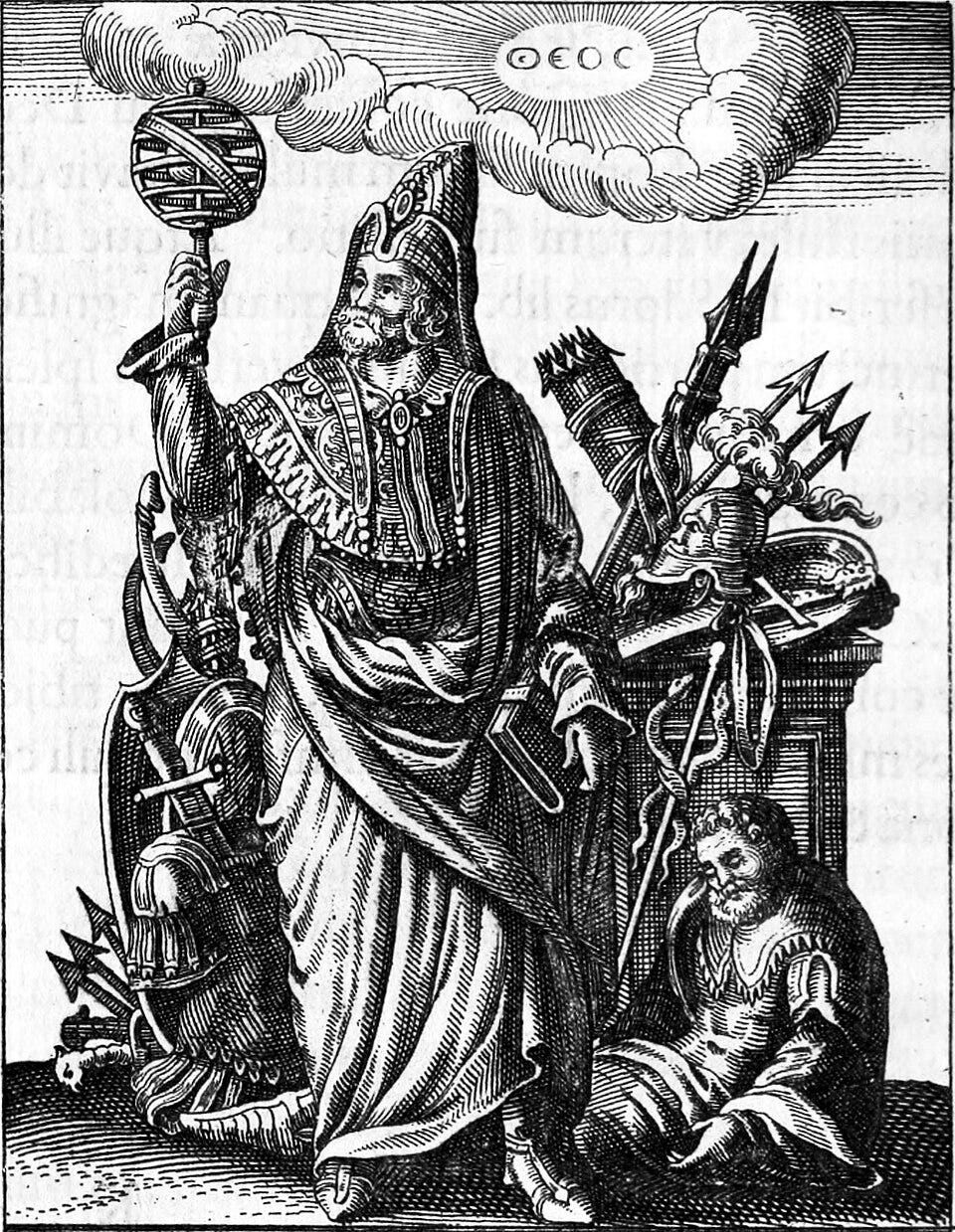

The most famous treatise in the collection is the Poimandres, which presents a vivid cosmological vision. In it, Hermes receives a revelation from a divine being who explains how the universe came into being. The story describes a fall of humanity into material existence, followed by the possibility of spiritual ascent. It reads like a mystical dream, full of symbolism and layered meaning.
Hermetic practices were less about ritual in the early texts and more about contemplation and spiritual discipline. The goal was purification of the mind and alignment with the divine order. Practitioners sought to transcend the illusions of the material world through meditation, ethical living, and philosophical reflection. The emphasis was on inner transformation rather than elaborate ceremony.
Over time, the ideas in the Corpus Hermeticum became closely linked with astrology, alchemy, and magic. Although these practices are not central in the earliest Hermetic texts, later traditions associated Hermetic wisdom with hidden sciences. The famous maxim as above so below, often tied to Hermeticism, expresses the belief that the macrocosm of the universe is reflected in the microcosm of the human being.
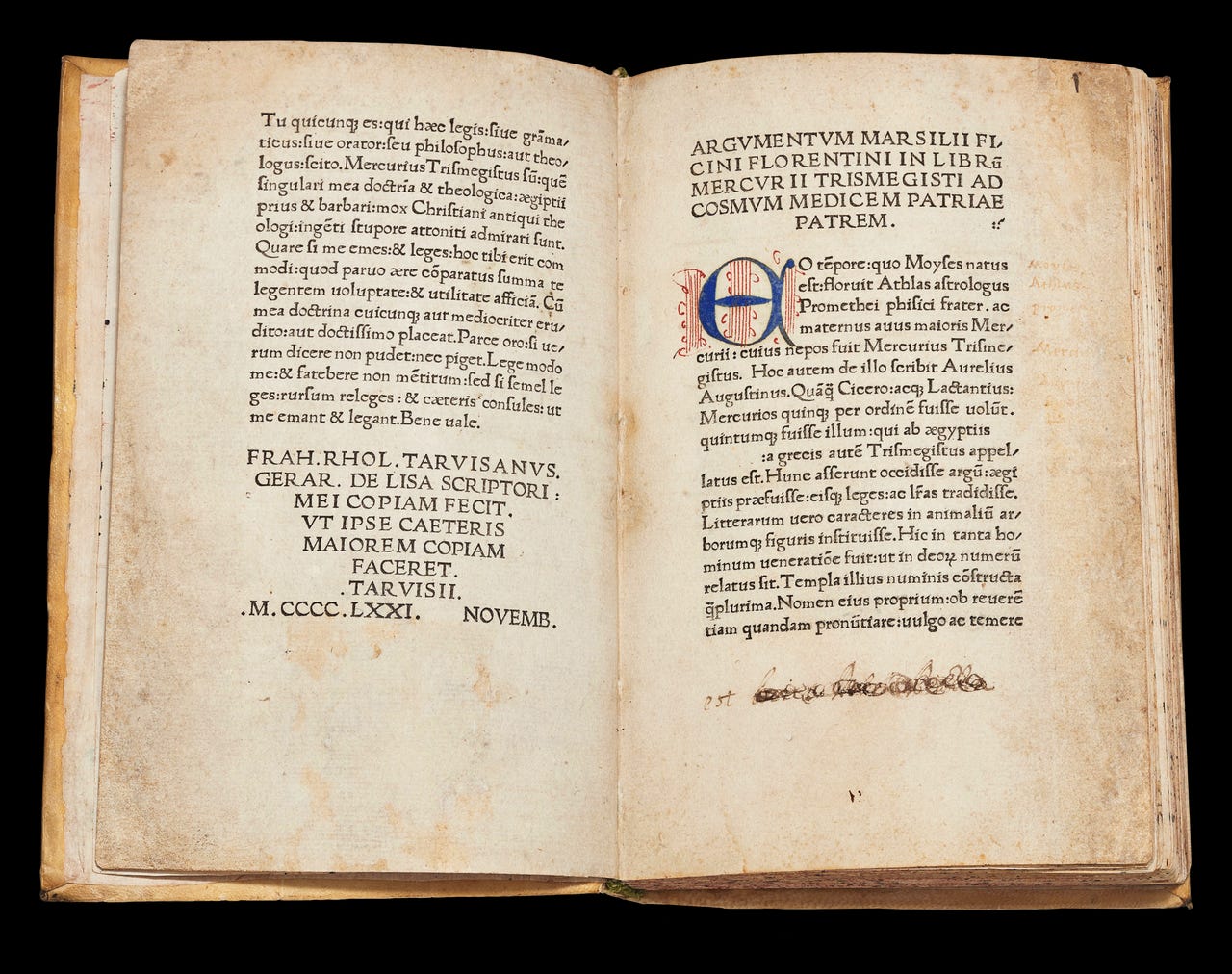
During the Middle Ages, Hermetic texts survived primarily in the Islamic world and in scattered manuscripts. They were not widely known in Western Europe until the Renaissance. Everything changed in the fifteenth century when a manuscript was brought to Florence and translated into Latin at the request of Cosimo de’ Medici.
The translation was carried out by Marsilio Ficino in 1463. Ficino believed the Hermetic texts were extremely ancient, predating even Plato. Because of this, Renaissance thinkers treated them as prisca theologia, or ancient divine wisdom. The Corpus Hermeticum suddenly became a foundational text for Renaissance esotericism.

The influence of Hermetic thought during the Renaissance was enormous. Thinkers such as Giovanni Pico della Mirandola embraced Hermetic ideas alongside Neoplatonism and Kabbalah. They saw in these writings a confirmation that humanity possesses immense spiritual potential. The idea that humans could rise toward the divine through knowledge and willpower became a powerful intellectual current.
In the seventeenth century, scholars began to question the supposed antiquity of the texts. A critical study by Isaac Casaubon demonstrated that the language of the Corpus Hermeticum dated to the early centuries of the Common Era, not to ancient Egypt. This revelation changed how scholars viewed the texts, but it did not erase their influence.
Even after their historical dating was corrected, Hermetic ideas continued to shape Western esotericism. Alchemists, Rosicrucians, and later occult societies drew on Hermetic principles. The emphasis on correspondence between different levels of reality became a key framework in magical practice. The notion that the universe is alive and interconnected remains central to Hermetic-inspired traditions.
Practices associated with Hermeticism today often include meditation on divine unity, study of symbolic systems, and ritual work aimed at personal transformation. Modern Hermetic orders may incorporate ceremonial magic, astrology, and alchemy as spiritual disciplines. While these practices vary, the underlying goal is still gnosis, the direct experience of divine truth.
At a philosophical level, the Corpus Hermeticum presents a profoundly optimistic vision of humanity. It teaches that while humans may be entangled in matter, they are not cut off from the divine. Through self-knowledge and inner purification, they can awaken to their true nature. This message has resonated with seekers across centuries.
In academic circles, the Corpus Hermeticum is now studied as part of the broader category of late antique religious philosophy. Scholars explore its connections to Platonism, Gnosticism, and early Christianity. Rather than seeing it as a relic of Egyptian antiquity, they understand it as a creative product of cultural exchange in the Hellenistic world.
Today, the Corpus Hermeticum continues to fascinate both scholars and spiritual explorers. Whether approached as historical literature, mystical scripture, or esoteric manual, it invites readers into a dialogue about the nature of reality and the human soul. Its casual conversations between master and student still feel surprisingly intimate. In those ancient words, many people sense the echo of a timeless search for meaning.
References
Corpus Hermeticum – The primary collection of Hermetic philosophical writings discussed throughout the article.
Hermes Trismegistus – The legendary figure traditionally associated with authorship of the Hermetic texts.
Cosimo de’ Medici – The Renaissance patron who commissioned the Latin translation of the Corpus Hermeticum.
Marsilio Ficino – The philosopher who translated the Hermetic texts into Latin.
Giovanni Pico della Mirandola – A Renaissance thinker influenced by Hermetic ideas.
Isaac Casaubon – The scholar who demonstrated that the Hermetic texts were written in the early Common Era rather than in ancient Egypt.