


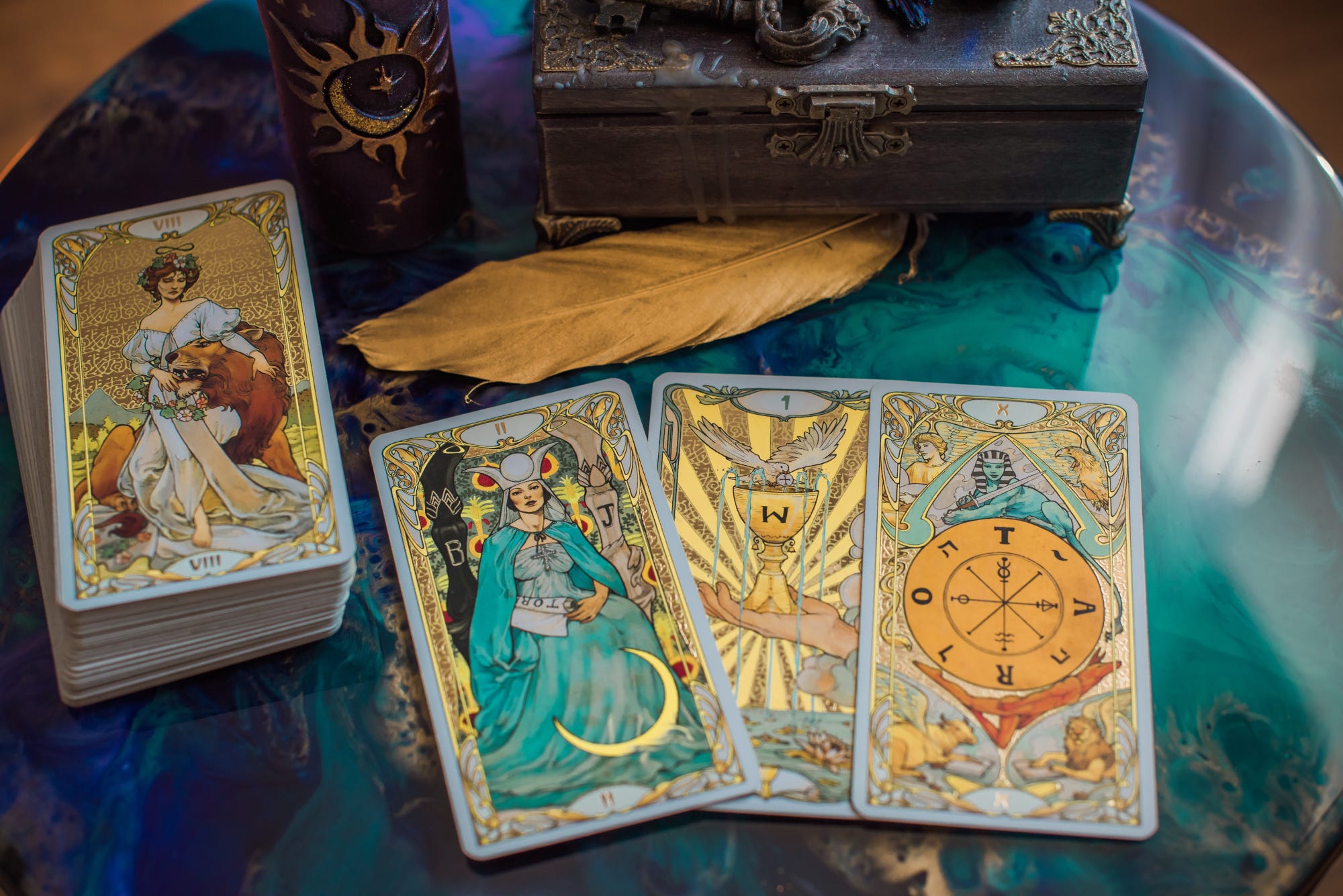
Tarot card reading has long held an aura of mystery, but its history is more grounded than many people realize. What most of us think of as an ancient occult tool actually began as a card game in Renaissance Europe. Over time, layers of symbolism, mysticism, and personal interpretation transformed Tarot into the spiritual and introspective practice we recognize today.
The earliest known tarot cards appeared in 15th century Italy, where they were called tarocchi. These decks were hand-painted and commissioned by wealthy families in cities such as Milan and Ferrara. One of the most famous early examples is the Visconti-Sforza Tarot, created for the ruling Visconti and Sforza families. At the time, tarot was used for trick-taking games rather than fortune telling.
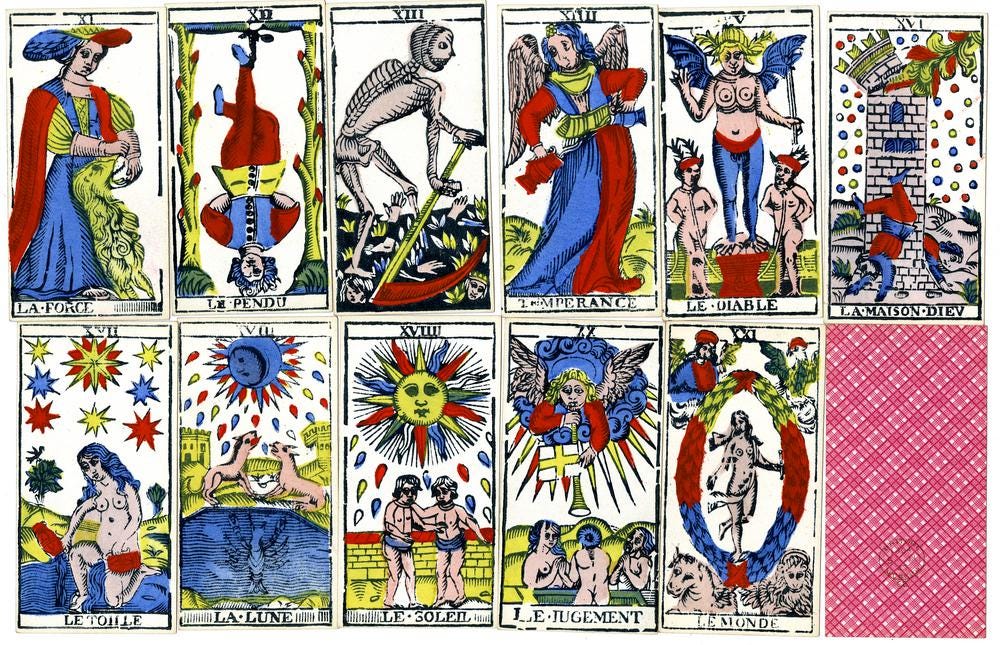
Tarot as a game spread to France and parts of Switzerland, becoming what is now known as Tarot or Tarock. The structure of the deck had already been established, including 22 trump cards and four suits. According to historian Michael Dummett, there is no evidence that the Tarot was originally designed for divination. The mystical associations came later.
.jpg)
The shift from games to esoteric tools began in the 18th century. French occultists began to connect Tarot imagery to ancient Egypt, Hermeticism, and hidden wisdom traditions. A key figure in this change was Antoine Court de Gébelin, who argued in 1781 that the Tarot contained secret Egyptian knowledge. Modern historians generally agree that these claims were fiction rather than historical fact.
Another influential occultist, Jean-Baptiste Alliette, was among the first to publish a deck specifically designed for divination. Etteilla (the pseudonym of Jean-Baptiste Alliette) gave detailed meanings to individual cards and developed spreads to read them. His work helped formalize the Tarot as a system of fortune telling rather than a parlor game.
In the late 19th and early 20th centuries, Tarot became closely associated with formal magic and secret societies. The Hermetic Order of the Golden Dawn played a major role in reshaping Tarot symbolism. Members integrated astrology, Kabbalah, and alchemy into the interpretations of the cards, creating a complex esoteric framework that still influences readers today.
One of the most widely recognized decks emerged from this movement. The Rider-Waite Tarot, illustrated by Pamela Coleman Smith under the direction of Arthur Edward Waite, featured fully illustrated scenes on all 78 cards. Published in 1909, this deck made the Tarot more accessible and visually intuitive, shaping modern interpretations for more than a century.
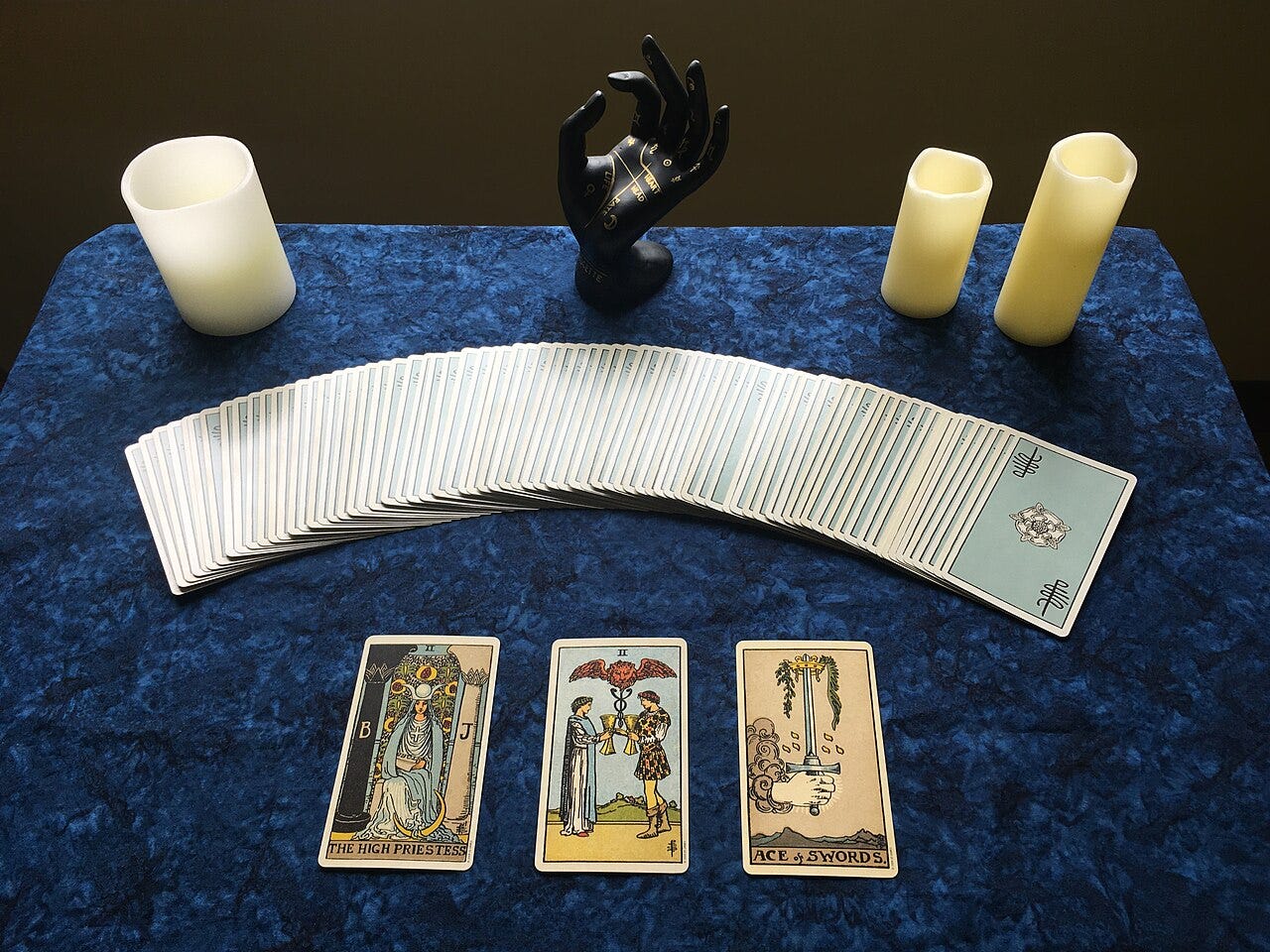

A typical Tarot deck consists of 78 cards divided into Major Arcana and Minor Arcana. The Major Arcana includes 22 archetype cards such as The Fool, The Magician, and Death, each representing major life themes and spiritual lessons. The Minor Arcana consists of four suits, usually Cups, Pentacles, Swords, and Wands, which reflect everyday experiences and emotional dynamics.
Tarot readings themselves vary widely in practice. Some readers follow structured spreads such as the Celtic Cross, while others draw cards intuitively. The cards are shuffled, placed in a specific pattern, and interpreted based on symbolism, situation, and the reader's intuitive insight. Context matters a lot, and the same card can take on different meanings depending on the question asked.
Psychologically speaking, many modern practitioners see the Tarot less as a tool for predicting certain outcomes and more as a mirror of self-reflection. Scholars and practitioners have compared Tarot to projective techniques, where symbolic imagery helps individuals explore subconscious thoughts and feelings. In this sense, the Tarot becomes a structured storytelling device rather than a supernatural oracle.
In the 20th century, Tarot expanded beyond esoteric realms into popular culture. The rise of New Age spirituality in the 1960s and 1970s brought the Tarot into bookstores and mainstream awareness. Today, countless themed decks exist, ranging from traditional symbolism to pop culture adaptations, reflecting diverse artistic and spiritual viewpoints.
Also, doubt remains part of the conversation. Many historians insist on documenting the Renaissance origins of tarot as a card game challenging the myths of its ancient Egyptian lineage. Academic studies continue to examine the Tarot as a cultural artifact shaped by European history rather than as a monolithic mystical tradition.
Ultimately, tarot card reading sits at the intersection of history, symbolism, psychology, and faith. From its beginnings in Italian courts in the 15th century to its current role in personal and spiritual exploration, the Tarot has constantly reinvented itself. Whether viewed as a historical curiosity, a contemplative exercise, or a spiritual tool, its enduring appeal lies in its rich imagination and the human desire to find meaning in the unknown.
References
Michael Dummett, The Game of Tarot: From Ferrara to Salt Lake City (1980).
This is one of the most important academic studies on tarot history. Dummett carefully documents tarot’s 15th century origins as a card game in Italy and strongly refutes claims of ancient Egyptian origins.
Michael Dummett, A Wicked Pack of Cards: The Origins of the Occult Tarot (1996), co-authored with Ronald Decker and Thierry Depaulis.
This book traces how tarot evolved from a Renaissance game into an occult system in the 18th and 19th centuries, focusing on French occultists like Court de Gébelin and Etteilla.
Antoine Court de Gébelin, Le Monde Primitif (1781).
This is the work in which he claimed tarot preserved ancient Egyptian wisdom. Modern historians cite this text as the starting point of the Egyptian origin myth.
Jean-Baptiste Alliette and his late 18th century instructional manuals.
Etteilla was the first to publish a tarot deck specifically for divination and to assign systematic meanings to each card.
Research on the Hermetic Order of the Golden Dawn.
Much of what we know comes from member writings and later analyses, including works by historian Ronald Decker and occult scholar R. A. Gilbert. The Golden Dawn integrated astrology, Kabbalah, and ceremonial magic into tarot symbolism.
The history of the Rider-Waite Tarot, illustrated by Pamela Colman Smith and conceptualized by Arthur Edward Waite.
Waite’s The Pictorial Key to the Tarot (1910) explains the symbolism behind the deck and reflects Golden Dawn influences.
Surviving 15th century decks such as the Visconti-Sforza Tarot, housed in institutions like the Morgan Library and the Accademia Carrara. These physical artifacts are key primary evidence of tarot’s Renaissance origins as playing cards.